Home Inspection Water Test: The Real Estate Agent Guide
Podcast Overview
A water test sometimes gets treated as an optional add-on at the inspection stage, something the buyer can decide on later. For agents working in markets with private wells, older municipal lines, or homes pulling from mixed sources, that mindset is a liability. The water test tells you whether the home's drinking water is safe, whether the plumbing is delivering it at usable pressure and flow, and whether there are contamination patterns that point to deeper issues with the property. It is one of the few inspection items that touches health, financing, and negotiation in a single result.
What a Water Test Actually Checks
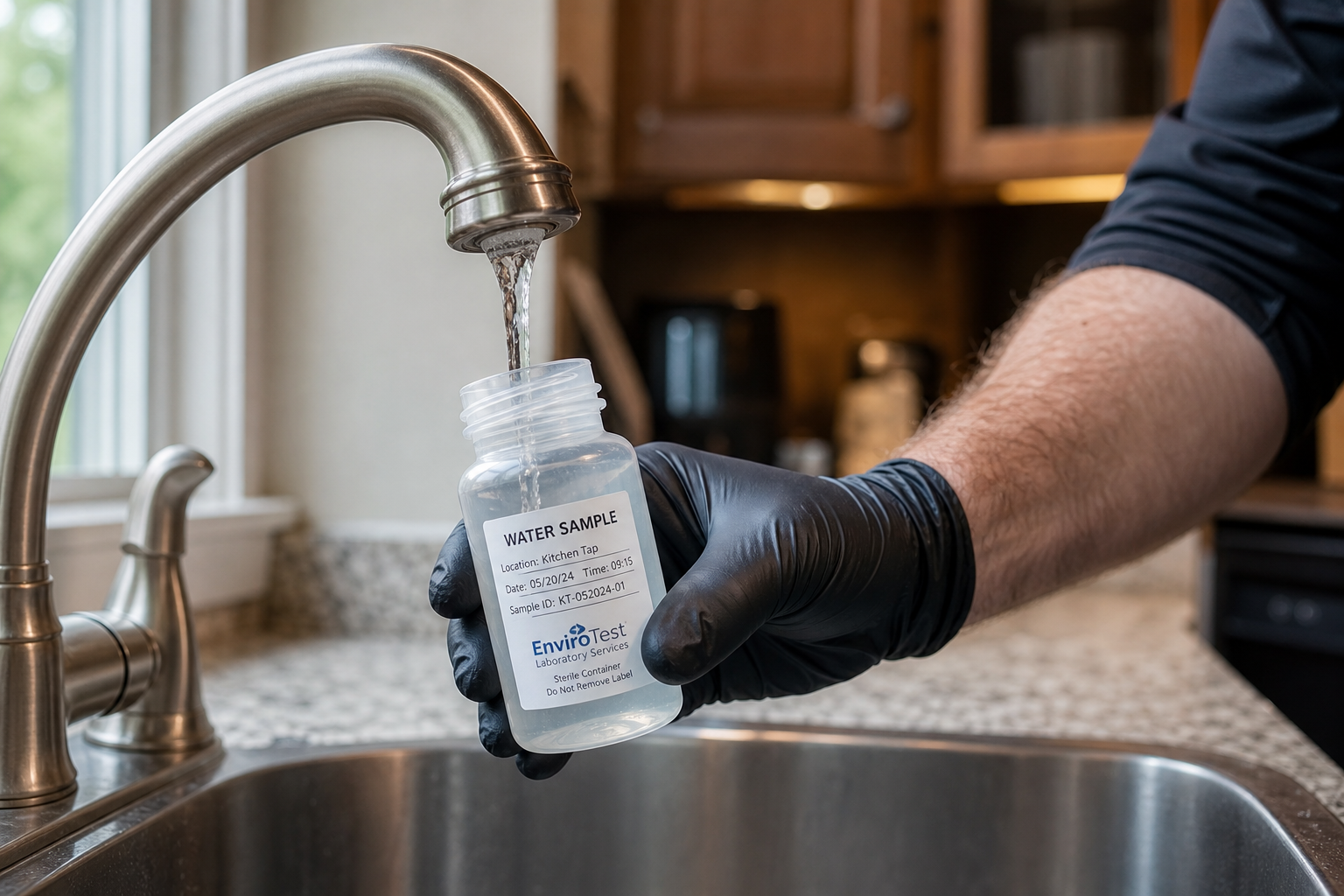
A standard residential water test is not a single test. It is a panel of assays performed on a sample drawn from the home, typically from an interior tap after the cold line has been allowed to run for a defined period. The lab then analyzes the sample for a set of contaminants and water quality markers. The standard panel for a private well usually includes total coliform bacteria, E. coli, nitrates and nitrites, arsenic, iron, manganese, hardness, pH, and (depending on the region) lead, uranium, radon in water, and volatile organic compounds.
Municipal water tests are narrower, since the utility is already monitoring for bacterial and chemical contaminants at the source. Testing on municipal water typically focuses on the service line and interior plumbing: lead from older fixtures or solder joints, copper levels, and sometimes chlorination byproducts. In both cases, the inspector also documents water pressure at one or more fixtures and may run a basic flow check.
Who Needs a Water Test and When
Lenders and loan programs drive much of this. VA loans require a water quality test for any home on a private well, and that test must meet the local health department's standards. FHA loans require well water testing in most cases, and USDA loans require it as well. Many conventional lenders defer to local custom, but in well-heavy markets the test is standard practice regardless of loan type. Homes that share a well between properties, homes with cisterns, and homes pulling from springs or surface sources almost always trigger a test.
On municipal water, a test is less universal but still relevant. Homes built before 1986 may have lead solder in interior plumbing, and homes built before the 1950s may still have lead service lines running from the street. A buyer who plans to have young children in the home, or who is sensitive to water quality issues, has a real reason to test even when the lender does not require it.
Reading the Panel: What the Numbers Actually Mean
The lab returns a panel with a result for each contaminant alongside the regulatory limit. The structure looks similar across most labs, even when the units differ. Coliform bacteria is reported as present or absent; any presence is a failure. E. coli is reported the same way and is the more serious of the two findings, since it points to fecal contamination. Nitrates above 10 milligrams per liter are unsafe for infants and a flag for older adults. Arsenic above 10 micrograms per liter exceeds the federal limit and is associated with well-known long-term health risks. Lead has no safe level for residential drinking water; the federal action level for utilities is 15 micrograms per liter, but for an individual home, agents should treat any detection as worth addressing.
Hardness, iron, and manganese are aesthetic and plumbing issues more than health issues, but they affect appliance life and water appearance. A pH outside the 6.5 to 8.5 range can corrode pipes and shorten the life of fixtures and water heaters.
Common Failures and What They Signal
The most common single failure on a residential well test is total coliform bacteria. It does not always mean the well is contaminated; it can mean the wellhead is unsealed, that surface water is reaching the well, or that the sample was taken under conditions that allowed contamination. The standard response is to shock-chlorinate the well and retest. The second most common failure is elevated nitrates, which often trace back to nearby agricultural use or an aging septic system. Arsenic failures are regional, common in parts of the Northeast, Upper Midwest, and Southwest, and they typically require a treatment system. Lead failures on municipal homes generally point at interior plumbing rather than the service line and are often addressed by replacing fixtures or installing a point-of-use filter.
How Agents Should Handle the Result
The water test result lands in the same window as the rest of the inspection report, usually within a few days of the lab pickup. Agents working buyer-side should read the result before talking to the client and before drafting the repair request. The framing of the conversation matters. A coliform-only failure is recoverable with a shock and retest, and the request is usually for the seller to perform that work and provide a passing retest before closing. An arsenic failure is structural and requires a treatment system; the request is usually for installation and a follow-up test, or a credit at closing for the buyer to handle the install. A lead failure on municipal water often calls for fixture replacement or a filter, depending on the source.
The agent's job is to translate the lab report into a clear, specific, justifiable request, and to set the client's expectations about what listing-side is likely to agree to.
What Listing Agents Will Push Back On
The most common pushback is on retest cost and timing. Listing agents will ask whether the buyer is willing to share the cost of a treatment system, whether a credit is acceptable in place of installation, and whether the closing date can hold while the retest comes back. Some will push back on scope, arguing that a coliform-only failure is a wellhead issue and that the seller should not be on the hook for a full treatment system. That argument is usually correct, and the buyer-side agent should be prepared to accept a shock-and-retest scope when the failure is bacterial only.
The harder conversations come on arsenic, uranium, and radon-in-water findings, where the seller may dispute the result or argue that the home has always tested fine. The right move is to push for a passing retest at the seller's expense rather than debate the original number. A second clean sample resolves the issue; a debate over the first one rarely does.
Timing in the Transaction
A standard water sample takes two to five business days at the lab, sometimes longer for arsenic, radon-in-water, and volatile organic panels. Build that into the inspection contingency window. If the test is borderline and a retest is needed, the second sample plus shock period plus lab turnaround can add another two weeks. Agents who get caught short on timing often end up with a closing extension or a deal that drifts past the contract date, and that gives the other side leverage. The cleanest path is to draw the sample on day one of the inspection window, and to treat any contingency extension as a known possibility rather than a surprise.
Common Misconceptions
A few persistent ideas slow agents down on water tests. The first is that a clear, odorless tap means the water is safe. Most of the serious contaminants, including arsenic, lead, nitrates, and bacteria, are invisible and tasteless at the levels that matter for a home inspection. The second is that a recent water test from the seller is acceptable in place of a current sample. Most lenders require a sample drawn within a defined window before closing, often 30 to 90 days, and a six-month-old result will not satisfy underwriting. The third is that municipal water never requires testing. Lead in interior plumbing is the obvious exception, and buyers in older urban housing stock have a real reason to test for it regardless of the utility's overall record.
Putting the Result to Work in Your Repair Request
Once the lab result is in hand, the work shifts from interpretation to communication. Agents who use InspectionResponse upload the inspection PDF and the water test result, and the platform extracts the relevant findings and turns them into prioritized, professionally worded repair requests with the health and safety language already framed for the listing side. The agent reviews, adjusts for local norms, and sends. It saves an hour of drafting and produces a request that lands cleanly the first time.
Additional Resources
Briefing Document & Key Takeaways
Title: Water Testing in a Home Inspection: An Agent Briefing
Audience: Real estate agents (buyer-side and listing-side), transaction coordinators, brokers, and informed buyers and sellers preparing for the inspection contingency period.
Purpose: Equip agents to understand what a residential water test covers, how to read the lab panel, how to respond to common failures, and how to negotiate repair language that protects the client without unnecessarily threatening the deal.
Key takeaways:
- A water test is required by VA, FHA, and USDA loans on private wells, and is good practice in older municipal housing stock with potential lead exposure.
- The standard well panel covers total coliform bacteria, E. coli, nitrates, arsenic, lead, and several aesthetic markers; the panel for municipal homes is narrower and focused on plumbing-side contaminants.
- Bacterial failures are usually recoverable with a shock and retest; arsenic, uranium, and lead failures typically require a treatment system or fixture work.
- Timing is a real constraint. Lab turnaround plus a possible retest can consume the full inspection contingency, so sampling should happen on day one of the window.
- Strong repair requests translate the lab numbers into specific, justifiable asks. Vague requests invite rejection; clear ones close.
Recommended use: Review before the inspection sample is drawn so the client understands the scope, and again before drafting the repair request so the lab numbers are framed correctly.
Study Guide
The Water Test in Context
- What is included in a standard residential water test panel for a private well?
- Why are VA, FHA, and USDA loan programs particularly attentive to water testing?
- When is a water test relevant on a home with municipal water service?
Reading the Lab Results
- How is a coliform bacteria result reported, and what does a positive result mean for the transaction?
- What is the federal action level for lead in water, and how should an agent treat any lead detection in a residential setting?
- What do elevated nitrates often indicate about the property's environment?
Negotiating After a Failure
- What is the appropriate repair request for a coliform-only failure?
- What is the appropriate repair request for an arsenic failure?
- What is the most common listing-side pushback on a treatment system request?
Timing and Logistics
- How long does a standard water sample take to come back from the lab?
- Why should the sample be drawn on day one of the inspection window?
- What is the risk of relying on a water test the seller provides from earlier in the year?
Application Exercise
You are representing a buyer on a rural property with a private well. The inspection report comes back clean on structural items, but the water panel shows total coliform bacteria present, nitrates at 7 milligrams per liter, and arsenic at 13 micrograms per liter. Closing is scheduled in 21 days. Draft the framework of your repair request, including which items you will ask the seller to remediate, which you will monitor, and how you will handle the timing.
Answer Key
The Water Test in Context
- The standard well panel typically covers total coliform bacteria, E. coli, nitrates and nitrites, arsenic, iron, manganese, hardness, pH, and (region-dependent) lead, uranium, radon in water, and volatile organic compounds.
- These loan programs require habitability and safety standards for the home's drinking water, and they will not fund a transaction where a private well delivers water that fails a local health department panel.
- A test is relevant on municipal water when the home was built before 1986 (potential lead solder), when the home was built before the 1950s (potential lead service line), or when a buyer is sensitive to interior plumbing contamination.
Reading the Lab Results
- Coliform is reported as present or absent. Any presence is a failure and triggers either a shock-and-retest or a deeper investigation of the wellhead and any potential surface water intrusion.
- The federal action level for lead in utility water is 15 micrograms per liter, but for an individual residential property, an agent should treat any lead detection as worth addressing through fixture work, plumbing remediation, or filtration.
- Elevated nitrates often indicate proximity to agricultural runoff or contamination from an aging or compromised septic system.
Negotiating After a Failure
- The typical request is for the seller to shock-chlorinate the well and provide a passing retest before closing, at the seller's expense.
- The typical request is for the seller to install a treatment system rated for arsenic, complete a passing retest, and provide documentation; alternatively, a closing credit for the buyer to install the system after possession.
- Sellers most often push back on the scope and cost of a full treatment system after a bacterial-only failure, arguing that a shock and retest is the correct fix and that a treatment system is over-scoped.
Timing and Logistics
- A standard sample takes two to five business days at the lab. Specialty panels for arsenic, radon-in-water, and volatile organic compounds can take longer.
- A day-one draw preserves time for a retest if the first result is borderline or failed. Late sampling forces a closing extension or rushed negotiation.
- Lenders generally require a sample drawn within a defined window before closing (often 30 to 90 days). An older seller-provided test will not satisfy underwriting and cannot be relied on for the repair request either.
Application Exercise Sample Answer
The arsenic result is the priority. At 13 micrograms per liter, it exceeds the federal limit of 10, and remediation requires a treatment system rated for arsenic. The repair request should ask the seller to install a certified arsenic treatment system and provide a passing follow-up test, or to provide a closing credit sized to the local install cost. The coliform-positive result is the second priority. Request a shock chlorination of the well and a passing retest before closing. The nitrates at 7 milligrams per liter are within the federal limit; note them on file and disclose to the buyer, but do not include them in the repair request. On timing, request that sampling and retesting begin immediately, and prepare a contingency extension request in case the arsenic install and retest do not complete within 21 days.
Glossary of Key Terms
- Arsenic: A naturally occurring element that, above 10 micrograms per liter in drinking water, exceeds the federal regulatory limit and is associated with long-term health risk.
- Bacteriological test: A water test that screens for the presence of coliform bacteria and E. coli in a sample.
- Cistern: A storage tank used to collect and hold water, often rainwater, for residential use.
- Coliform bacteria: A broad group of bacteria whose presence in drinking water indicates possible contamination of the water source or the plumbing.
- Contingency period: The defined window in a purchase contract during which the buyer can investigate the property and request repairs or terminate.
- E. coli: A specific coliform bacterium whose presence in drinking water indicates fecal contamination and is a serious health concern.
- FHA loan: A loan insured by the Federal Housing Administration; requires well water testing in most cases when the home is on a private well.
- Flow rate: The volume of water a plumbing system delivers in a given time, typically measured in gallons per minute.
- Hardness: The measure of dissolved calcium and magnesium in water; high hardness is an aesthetic and plumbing issue, not a health issue.
- Inspection contingency: The contractual right of the buyer to inspect the property and respond to findings before the contingency deadline.
- Iron: A common well water contaminant that causes staining and taste issues at elevated levels.
- Lead: A toxic metal that can enter drinking water from lead service lines, lead solder, or older fixtures, with no safe residential level.
- Lead service line: The portion of plumbing from the street main to the home, made of lead in many older urban properties.
- Manganese: A common well water contaminant that causes staining and aesthetic issues, with possible health effects at very high levels.
- Municipal water: Water delivered to the home by a public utility, typically already monitored at the source for contaminants.
- Nitrate: A nitrogen compound that, above 10 milligrams per liter, is unsafe for infants and a concern for some adults; often linked to agricultural runoff or septic issues.
- pH: A measure of acidity or alkalinity. A residential pH outside the 6.5 to 8.5 range can corrode pipes and damage fixtures.
- Point-of-use filter: A filtration device installed at a single fixture (often a kitchen tap) to address contaminants in the water at that point of use.
- Potable water: Water that is safe for human consumption.
- Private well: A water source on the property that draws from groundwater rather than from a municipal utility.
- Radon in water: A radioactive gas that can enter drinking water from certain geologic conditions and is a regional concern.
- Repair request: The buyer's formal post-inspection request asking the seller to remediate specific findings before closing.
- Retest: A second water sample drawn after remediation work, used to confirm that the issue has been resolved.
- Septic system: A private wastewater treatment system used at properties without municipal sewer connection.
- Service line: The pipe that delivers water from the street main into the home.
- Shock chlorination: A remediation method for a contaminated well in which a chlorine solution is introduced, circulated, and flushed to disinfect the system.
- Treatment system: A whole-home filtration or remediation system rated for one or more specific contaminants.
- Uranium: A naturally occurring radioactive element that can appear in groundwater in certain regions and requires treatment when above regulatory limits.
- USDA loan: A loan backed by the U.S. Department of Agriculture, used for rural properties and requiring water testing on private wells.
- VA loan: A loan guaranteed by the Department of Veterans Affairs; requires water quality testing on any home with a private well.
- Volatile organic compound (VOC): A class of carbon-based chemical contaminants, often industrial in origin, that can appear in groundwater.
- Wellhead: The above-ground termination point of a well, including the casing and cap.
Frequently Asked Questions
What is a water test in a home inspection?
A water test is a lab analysis of a water sample taken from the home during the inspection contingency period. The sample is screened for bacterial, chemical, and aesthetic contaminants, and the results inform repair requests, lender conditions, and the buyer's decision to move forward.
Is water testing required by law?
It is not universally required, but lender programs make it effectively mandatory in many transactions. VA loans require water testing on any home with a private well, and FHA and USDA loans require it in most well-served properties. Local health departments and state programs may also set requirements.
Who pays for the water test?
The buyer almost always pays for the initial water test as part of the inspection. If the result fails and a retest is required, the cost of the retest is usually written into the repair request and assigned to the seller, particularly when remediation work is part of the same request.
What contaminants does a standard water test cover?
A standard well panel typically covers total coliform bacteria, E. coli, nitrates, arsenic, iron, manganese, hardness, and pH. Region-specific panels add lead, uranium, radon in water, and volatile organic compounds. Municipal panels focus on plumbing-side issues like lead and copper.
What is the most common reason a well water test fails?
Total coliform bacteria is the most common failure. It often indicates an unsealed wellhead, surface water intrusion, or sample-side contamination rather than a deeply contaminated well. The standard response is shock chlorination and a retest, not a full treatment system.
Should I test the water on a municipal home?
A test is worth recommending when the home was built before 1986 (lead solder is possible) or before the 1950s (lead service line is possible), and when the buyer is sensitive to interior plumbing contamination. The test is narrower than a well panel but still meaningful.
What is shock chlorination?
Shock chlorination is a remediation method in which a strong chlorine solution is introduced into the well, circulated through the plumbing, and then flushed out. It disinfects the well and lines and is the standard fix for a coliform-only failure, paired with a retest to confirm.